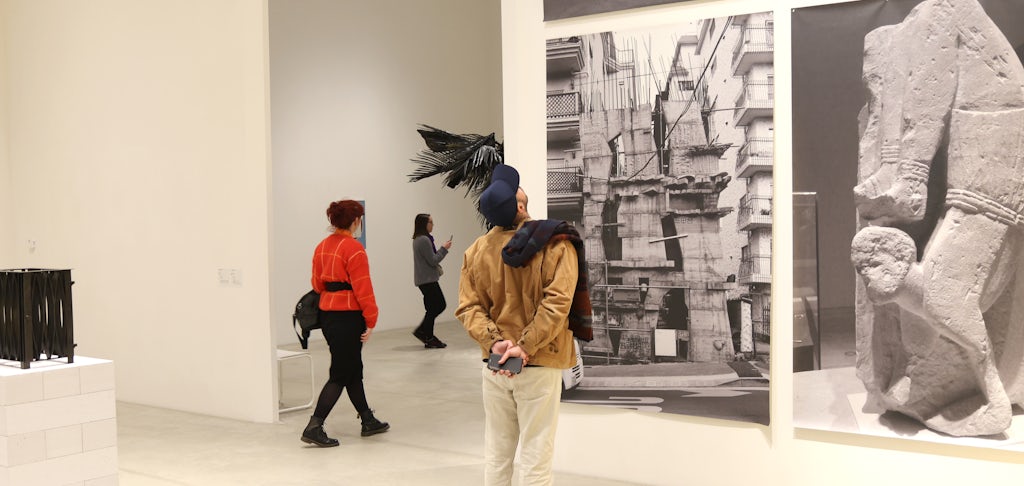
Photo by Panos Kokkinias
Katerina Gregos interviewed by Antonio Scoccimarro for Mousse Magazine No. 34.
Problems regarding human rights have become more global than ever. The “Newtopia” exhibition will be divided into thematic areas carefully analyzing changes in the concept of “human rights” from the post-war period until today. From a historical perspective, how would you define the period we are currently experiencing?
Since the adoption of the Universal Declaration of Human Rights by the United Nations General Assembly on 10 December 1948, and even more so since 1976, when the Bill took on the force of international law, the issue of human rights has been put high on the agenda, on many occasions, in many countries. One can truly speak of the rise of human rights, particularly since the 1970s, as Samuel Moyn has argued very well in his book The Last Utopia, which has been one of the points of reference for the exhibition. Nowadays, respect for human rights is often demanded and used as a means of putting political pressure on countries who need the help of the international community in order to reach certain goals.
Look at Turkey, for example, where the issue of human rights, and in particular the status of the Kurds, is of high importance for its negotiations with the European Union. Or take the example of Apple and Foxconn, who agreed to drastically improve the working conditions in their Chinese plants, under the pressure of the Fair Labor Association report. Apple has even joined the Fair Labor Association. More and more institutions are now acting as watchdogs for the maintenance and improvement of human rights, such as Human Rights First (1978), Human Rights Watch (1988), Human Rights Without Frontiers (1988), Human Rights Defence (2005), Human Rights Foundation (2005), to just name a few with the words Human Rights in their names. On the internet one can find hundreds of non-profit NGOs dealing with the protection of human rights. So there is undoubtedly an increased awareness of the subject, as well as double standards — the down side — in the argumentation and implementation of human rights (the hypocritical attitude of the West when it chooses to support human rights in certain cases and ignore them in others, depending on political and economic interests).
At the moment, in contradiction to this rise, and particularly in the West, we are experiencing a regression in human rights owing to the highly conservative political climate that has consolidated in the aftermath of
9/11, where civil liberties are being curtailed in the name of safety and security, public space is being eroded, surveillance has become a de facto practice even in open so-called “open societies” and democratic countries in Europe; and xenophobia, right-wing politics and anti-immigrant sentiment is on the rise. We tend to associate the violation of human rights with predominantly authoritarian regimes, often disregarding the human rights violations that take place under our noses in European society, for example (one of them is the dismal treatment of illegal immigrants). So there is still a huge amount of work to be done in spreading
awareness of human rights and putting into place legislation that implements them. And then there is the “violence of financial capitalism”, to borrow a phrase from Christian Marazzi, the results of which can be seen
in Greece now due to the impossibly harsh measures imposed by the Troika and the EU. So the question of human rights is double and quite complex: there is advancement on the one hand, and regression on the
other. In any case, human rights will always be an ongoing, unfinished project; in that sense it can be seen as the ultimate utopian project for humanity, a project—in-progress of universal significance, which can never be fully attained, but whose impact and benefits are always going to be worth fighting for if we are to strive for improved living conditions and dignity for those who lack them.
The title of the exhibition, "Newtopia ”, openly states that it will examine relationships between history and utopian thought, and the possible resources that a renewal of the concept of utopia could bring to the contemporary world.
In 7979 Margaret Thatcher was one of the leading players in the slow demolition of any utopian vision of the modern world that dzieredfiom the free-market economy, famously saying, "There is no alternative.” In a historical period in which alternative responses to the neo-liberal model seem to be absent or very weak — due in part to decades of work on educating people not to perceive alternatives to the existing model, along with a lack of true channels of communication that can contrast this vision — what scenarios do you envisage?
I don’t agree with your idea that there is a lack of true channels of communication. I think that the social media have proven to be perfect means of communication for the exchange of ideas and to mobilize large amounts of people. Just think of what happened in North Africa, where in many countries a revolution was organized quickly and conclusively.
It must be said that since the neo-liberal model seems to have failed fundamentally (though so many people in power are in complete denial of this), and the entire world economy is in danger of collapsing, the need
for the development of alternative socio-political and economical models is more urgent than ever before. I think that the grand overarching models, as we have known them in the past, have proven to be useless.
It probably is not the models themselves that have failed, but in general the people we made responsible for their execution have failed. Grand visions need grand — and selfless, incorruptible — leaders, and they just
don’t seem to be out there; or they run the risk of being corrupted soon after they come into power. The problem of growth is not well understood, I am afraid. It is obvious that unlimited, never-ending growth
— something which capitalism and modernity have been endlessly propounding - is an impossibility. And in this striving for constant growth and accumulation of wealth and material goods comes the problem of greed, which does not alleviate the situation. The belief in growth is nevertheless very widespread. I believe that we have to go back to small, more self-sufficient communities, working on smaller-scale projects, and scaling down our own material needs. One example is the small enterprises that are set up nowadays with this so-called micro-credit. That is in my opinion a good way to make people economically independent and proud of what they produce. And of course, we need new political and economic alternatives; I do not see them out there at the moment, but they are bound to come, as we are in a political impasse and have been for a long time, and capitalism seems to be at a tipping point.
What role can art and artists play in this system? How can a category that has also been a victim of the logic of the market construct a real alternative?
Artists have always been dealing with alternative ways to envisage, approach, and think about the world. Artists are important for society in the sense that they constitute a free-floating independent intelligence.
In fact, the art market is not or should not be of any consequence to what artists are producing. The social responsibility of an artist is in the first place to contemplate our society and show us different, unusual and
surprising ways of looking at reality. Their artistic responsibility is to make art. Art perhaps cannot change the world, but it can help to change people’s ideas of the world, to open up new perspectives, overlooked before, which is a very powerful form of communication. Art, music, literature, and theater in general have always been an inspiration for hope, change, and improvement. Artists will in general very likely not construct or design real alternatives, that is not their primary role in any case, but they are able to show us how we can look differently at different problems from different angles, and inspire us to think differently about our own possibilities for imagining or even devising a better world.